

Start With 300 to 500 Responses: Museum Audience Segmentation Playbook

Updated: 3 days ago

Museum audience segmentation groups visitors by their motivations and behaviors so your programming, messaging, and ad spend actually match who is walking through the door. The fastest path to a usable segmentation is not a six-month academic study. It is a focused motivation survey, a k-means cluster analysis on the results, and a validation pass with your frontline staff before you pilot targeted messaging on a small budget.
TL;DR:
Segmentation based on motivations or behaviors provides more targeted messaging, improving conversion rates, program fit, and repeat visits, especially when supported by small-scale surveys.
Motivational models, such as visitor roles or axes like stimulation versus absorption, are most effective for redesigning visitor experiences, while demographic models suit media targeting.
Combining survey data with ticketing and CRM insights yields more stable, actionable visitor groups, with sample sizes from 300 for small museums to over 90,000 for national surveys.
Validating segments with frontline staff and intercept interviews helps ensure profiles accurately reflect true visitor patterns before launching targeted campaigns.
Effective segmentation requires ethical data collection, including informed consent, oversampling underrepresented groups, and regular updates to prevent segment staleness.
Table of Contents
What Is Museum Audience Segmentation and Why Does It Matter?
Segmentation is different from building a single “target audience” persona and writing to it forever. A persona is a guess dressed up as a profile. Segmentation is a structured grouping of real visitors based on what actually drives them: their motivations, their visit patterns, or their demographics, depending on which lens fits your question.
The payoff shows up in three places. Marketing gets sharper because you stop sending the same message to a solo researcher and a family chasing a rainy-day activity. Programming gets better fit because education teams can design for actual motivational clusters instead of assumptions. Budget stretches further because ad dollars go where a segment is already primed to respond.
Museums that apply this well tend to see it in specific numbers: higher membership conversion from targeted renewal messaging, stronger attendance at niche programs promoted only to the segment that wants them, and better repeat-visit rates once messaging stops treating every visitor as identical.
Better targeting: fewer wasted impressions on audiences unlikely to convert
Improved program fit: exhibits and events designed around real motivational clusters
Efficient resource use: staff and budget aimed at the segments most likely to act
Increased repeat visitation: messaging that speaks to why someone came back once
Which Segmentation Models Actually Work for Museums?
Three lenses cover almost every practical use case, and Art UK’s segmentation guide frames them the same way: demographics, behaviors, and interests or motivations. Each answers a different question, and picking the wrong one wastes your research budget.
Demographic segmentation groups by age, income, location, or family status. It is useful for media buying and reach planning, but it tells you almost nothing about why someone visits.
Behavioral segmentation groups by what people actually do: ticket type, visit frequency, membership status, event attendance. It is grounded in data you likely already have in your ticketing system.
Psychographic or motivational segmentation groups by underlying drivers, and this is where the most influential museum models live:
John Falk’s visitor identity model sorts people into roles like Explorer, Facilitator, Experience Seeker, Professional/Hobbyist, and Recharger, based on why they come, not who they are.
Audience Spectrum and Culture Segments classify people by cultural engagement habits and attitudes, widely used across UK arts organizations for planning outreach.
Motivation-axis models, like the drivers used in the Museums Victoria segmentation project, plot visitors on axes such as stimulation versus absorption to produce distinct segments.
Use motivation-based models when you’re redesigning the visitor experience. Use demographic models when you’re planning media reach and targeting geography or life stage.
How Do You Design a Survey and Run Cluster Analysis?
Good segmentation research rests on a mix of self-reported and observed data. Surveys capture motivation and intent; ticketing and CRM records capture what people actually did. Neither alone tells the full story, and motivation-theory research on visitor clusters consistently shows that combining both produces more stable, more actionable groups than surveys alone.
Rating-scale statements are the backbone of the survey. Write eight to twelve items tied directly to motivations and experience preferences, each scored on a five- or seven-point agreement scale. A statement like “I come here to learn something new” measures a different driver than “I come here to relax and unwind,” and both need their own item.
Draft eight to twelve rating statements mapped to known motivational drivers, not generic satisfaction questions.
Standardize the scores, then run k-means clustering with k ranging from two to six segments.
Check cluster stability by rerunning the model on random subsamples before trusting the output.
Profile each resulting cluster against demographics and visit behavior to give it a name and a story.
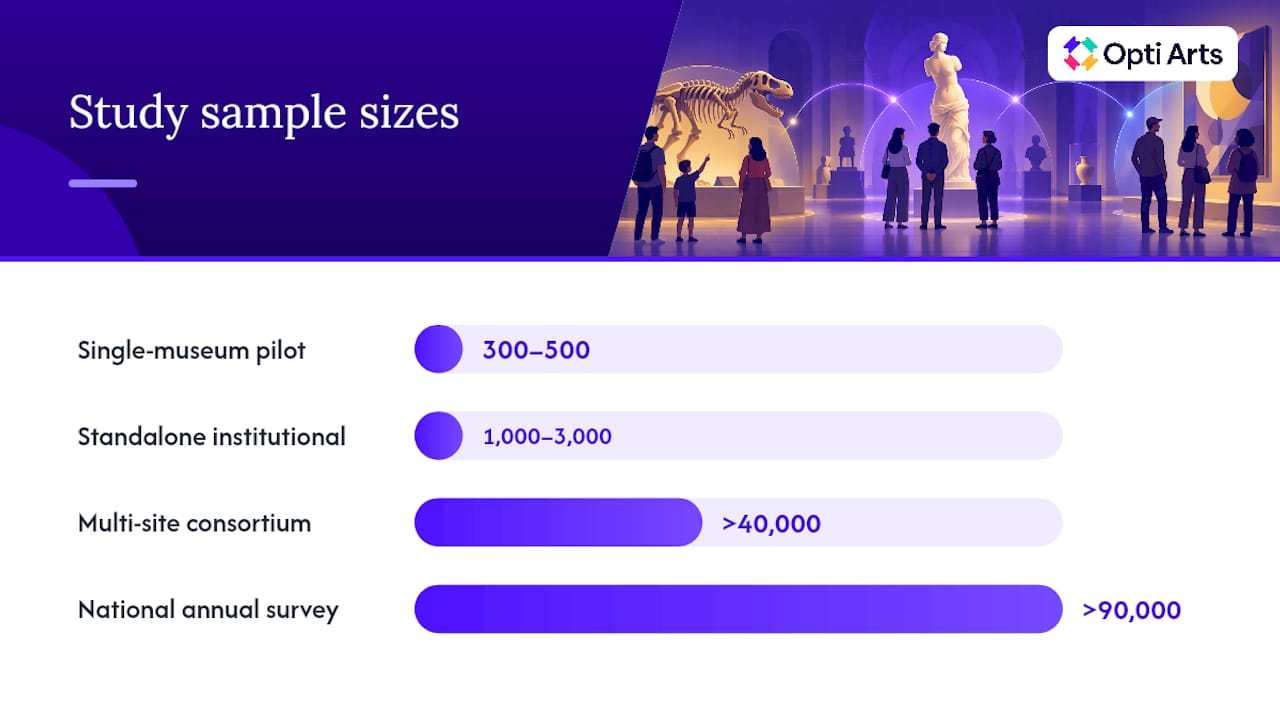
Sample size sets how much you can trust the clusters. The table below shows how scale changes what a segmentation study can support.
Study scale | Typical sample | What it supports |
Single-museum pilot | 300–500 exit responses | Two to three broad segments, directional only |
Standalone institutional study | 1,000–3,000 | Four to six stable segments with demographic profiling |
Multi-site consortium (COVES) | More than 40,000 pooled responses source | Benchmarked segments comparable across institution types |
National annual survey (AAM) | Over 90,000 respondents across 202 museums source | Sector-wide motivation and repeat-visitation patterns |
A single small museum rarely needs AAM’s scale of data. But joining a consortium study like COVES gets you benchmark-quality segments without funding a 40,000-response survey yourself.
How Do You Build and Validate Segments Step by Step?
Step 1: Set the research goal. Decide whether you’re exploring unknown motivations, describing an existing visitor base, or evaluating whether a program change worked. Each goal changes what you measure and how you’ll judge success.
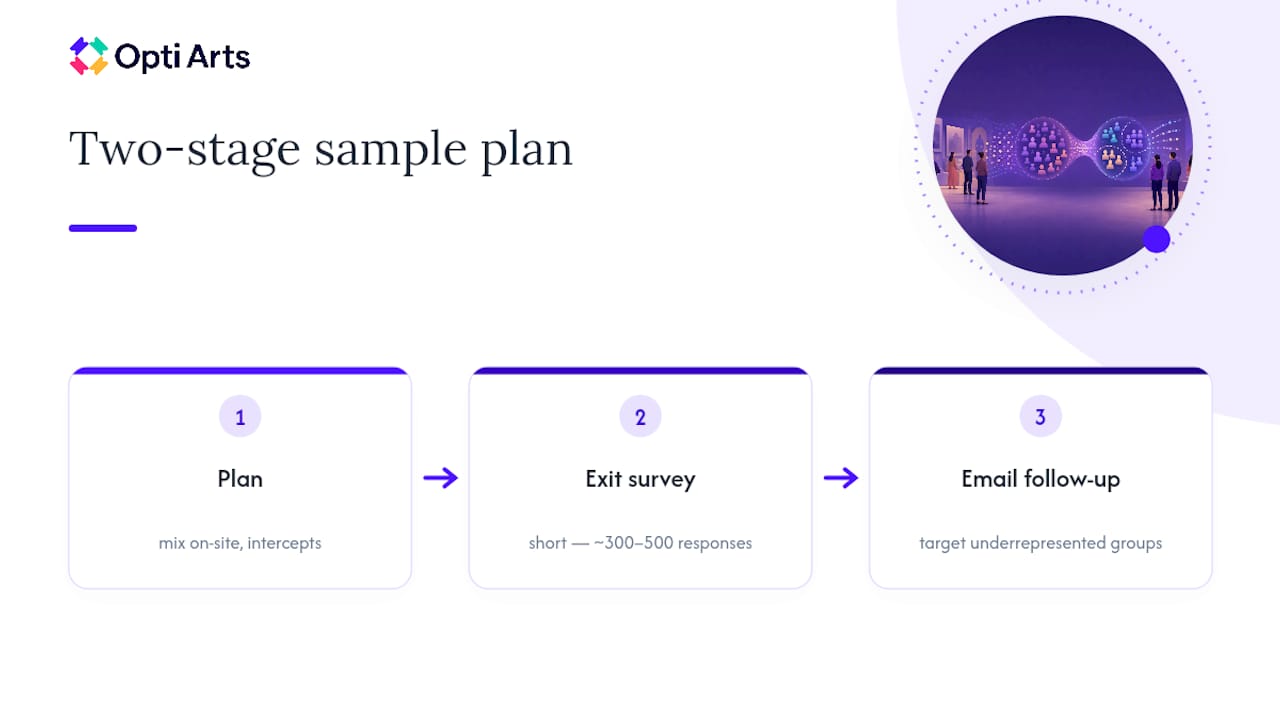
Step 2: Build the sample plan. Mix on-site exit surveys, email panels sent to members, and intercepts at specific programs. A two-stage approach works well on a limited budget: a short exit survey (roughly 300 to 500 responses) paired with a targeted email follow-up aimed at underrepresented groups.
Step 3: Analyze and validate. Run the cluster analysis, then bring results to frontline staff. Docents and visitor-services teams recognize patterns in real behavior that a spreadsheet cannot. Follow up with 20 to 30 intercept interviews per cluster to confirm the profile matches lived experience, an approach documented in cluster-analysis workflows for museum audiences.
Step 4: Pilot and measure. Choose one segment, write messaging aimed only at that group, and run it through a single channel for four to six weeks. Define your KPIs before launch, not after.
Pro Tip: Run your staff validation workshop before you finalize segment names. Frontline teams will tell you within minutes if a cluster label doesn’t match what they see at the admissions desk, and that catch is far cheaper before the segment ships into a campaign.
How Do You Turn Segments Into Marketing and Programming Actions?
A segment profile is only useful once it fits on a single page. Following the operational approach in Art UK’s collections guide, each profile should carry three things: the segment’s top needs, two sample messages, and its priority channels. Anything longer gets ignored by busy marketing and education teams.
From there, the mechanics are straightforward:
Feed segment tags into your CRM so ticketing history and email behavior link to the same profile.
Build paid social and email creative variants per segment rather than one generic campaign.
Personalize subject lines and ad copy around each segment’s stated motivation, not a generic call to action.
Track visit frequency, conversion rate, membership sign-ups, and Net Promoter Score by segment, reviewed monthly.
The AAM’s 2024 survey data found repeat visitation rates vary meaningfully by museum type, with art museums showing stronger returning-visitor patterns than some other categories. That gap alone justifies segment-specific retention messaging instead of one blanket newsletter.
Framing segmentation as one link in a larger chain (research feeds a visitor experience map, which feeds content production, which feeds the marketing funnel) keeps departments from treating it as a one-off project, an approach AAM’s nurturing model lays out clearly.
How Do You Keep Segmentation Ethical and Inclusive?
Segmentation research collects real personal data from real visitors, and that carries responsibility. ICOM’s Code of Ethics calls for informed consent, data minimization, and transparent use, plus a firm rejection of extractive research that takes visitor information without giving anything back to the community studied.
There’s a sampling risk too. AAM’s breakdown of visitation by museum type found frequent visitors skew less diverse than casual, first-time visitors at many institutions. A segmentation study that only surveys frequent visitors will bake that skew into every segment it produces.
Get explicit consent and explain how survey data will be used before collecting it.
Collect only the data fields your research question actually requires.
Actively oversample underrepresented visitor groups to correct for skewed frequent-visitor samples.
Set a retention policy, restrict data access, and train frontline staff on how segments get used.
Revisit and update segments on a fixed schedule rather than letting them calcify for years.
What Segment-Driven Campaigns Actually Look Like in Practice
We map each segment’s stated motivation directly to ad channel and creative: a Recharger segment gets calm, visual Meta creative; an Explorer segment gets discovery-driven YouTube and search campaigns. Museums that align creative to segment motivation typically see stronger ticket-sales lift than blanket campaigns, based on patterns we track across client accounts. Start small: pilot one segment on one channel before scaling the strategy sector-wide.
— Trevor
How Opti Arts Helps Museums Act on Segmentation Research
Running a solid segmentation study is only half the job. The other half is getting each segment’s message onto the right channel, at the right moment, without burning budget on guesswork. Some digital marketing agencies build campaigns specifically for cultural organizations, matching segment profiles to Meta, Google, YouTube, Spotify, and Connected TV placements instead of forcing every visitor group through the same generic ad set.
Our solutions cover the full channel mix, so a Recharger-motivated segment can get calm streaming audio creative while an Explorer segment sees a YouTube discovery campaign, all tracked from the same account. Once campaigns launch, the Breakeven dashboard ties ad spend to real ticket sales in real time, so you can see which segment’s messaging is actually converting instead of waiting for a quarterly report. A typical engagement starts with one pilot segment and one channel, then scales once the data shows what’s working. If your team has a validated segmentation study sitting in a drawer, get in touch through Opti Arts and let’s turn it into a measurable campaign.
Sources
FAQ
What Are the Four Main Types of Audience Segmentation?
The four most commonly used types are demographic, behavioral, psychographic, and geographic segmentation. Museums lean most heavily on demographic (age, income, location), behavioral (visit frequency, membership status), and psychographic or motivational segmentation (why someone visits, as in John Falk’s visitor identity model).
What Are the Five Types of Museum Visitors?
Definitions vary by model, but John Falk’s widely used framework identifies five visitor identities: Explorer, Facilitator, Experience Seeker, Professional/Hobbyist, and Recharger. Each identity reflects a different underlying motivation for the visit rather than a demographic trait, which is why the model informs experience design more than media targeting.
What Are the Five Categories of Audience Analysis?
A practical version covers demographics, psychographics, behavior, needs and pain points, and channel or media habits. Museums typically pull demographic and behavioral data from ticketing and CRM systems, then layer in motivational data from surveys like the ones behind the AAM 2024 Annual Survey.
How Many Survey Responses Do I Need for a Reliable Segmentation Study?
A single-museum pilot can produce directional segments with 300 to 500 exit survey responses. For stable, demographically profiled segments, aim for 1,000 to 3,000 responses, or join a multi-site consortium study like COVES to get benchmark-quality data without running the full sample yourself.
Does Opti Arts Help With Audience Segmentation Directly?
Opti Arts does not run the original visitor research, but it takes your existing segments and builds paid-media campaigns and dashboards around them across Meta, Google, YouTube, and Connected TV. Pricing for campaigns and the Breakeven dashboard is available on request through the Opti Arts site.
Recommended